Premium Coach Huub
Why Teaching Too Much in Webinars Kills Sales—and What to Do Instead
Introduction
Have you ever delivered a value-packed webinar, and shared tons of insights, and yet… no one bought your offer?
If that sounds familiar, you’re not alone.
Many experts believe that the more they teach in a webinar, the more likely their audience will trust them and buy from them.
But in reality, teaching too much actually lowers your sales.
Here’s why: When you give away too much information, attendees feel like they’ve already gotten everything they need. Instead of taking action and buying your program, they leave your webinar feeling overwhelmed or satisfied—both of which stop them from making a purchase.
The goal of a webinar isn’t to turn attendees into experts.
It’s to shift their beliefs, create a desire for transformation, and position your offer as the only logical next step.
In this blog, we’ll uncover:
The hidden dangers of over-teaching in webinars.
The right way to structure your content for engagement and sales.
A simple framework to educate, inspire, and convert without overwhelming your audience.
By the end, you’ll know exactly how to turn your webinar into a sales machine—without sacrificing value or credibility.
Let’s dive in!
The Problem – Why Teaching Too Much Kills Sales

Many coaches, trainers, and consultants believe that the more they teach, the more valuable their webinar will be—and that value will naturally lead to sales. Unfortunately, this logic backfires and results in lower conversions.
Here’s why:
1. Information Overload Leads to Inaction
When attendees are bombarded with too much information, they feel overwhelmed.
Instead of gaining clarity, they feel lost in the details and struggle to see a clear next step. And when people feel overwhelmed, they avoid making decisions—including buying your offer.
Imagine attending a 90-minute webinar where the host dives into all the strategies, frameworks, and tools they use.
By the end, you might feel like you just attended a crash course, but instead of feeling excited, you’re mentally exhausted. And what happens when people feel overloaded?
They do nothing.
2. Teaching Too Much Makes Your Offer Unnecessary
If you give away all the answers, why would attendees need to buy from you?
When your webinar solves all their problems upfront, your audience walks away thinking, "Great, I got what I needed!" instead of, "I need more of this!"
The key to selling successfully is to create a gap between what they know and what they need to implement—and show them that your program bridges that gap.
3. Attendees Shift Into 'Student Mode' Instead of Buyer Mode
When you overload attendees with too much teaching, they slip into "student mode"—taking notes, analyzing information, and thinking, "I’ll apply this later." But later never comes.
Instead of making an emotional decision to invest, they become spectators who passively consume knowledge rather than buyers ready to take action.
4. Teaching Lacks Emotional Connection
Webinars that focus heavily on teaching often lack emotional engagement. And people buy based on emotion, then justify with logic.
If your webinar is purely educational, it won’t create the urgency, excitement, or desire needed for people to say "I need this NOW." Instead, they think, "This is great information. I’ll try to figure it out on my own."
The Real Goal of a Webinar
Instead of overwhelming attendees with too much teaching, your webinar should focus on belief-shifting, desire creation, and positioning your offer as the only solution.
In the next section, we’ll break down the powerful shift from teaching to selling through storytelling—so you can educate, inspire, and convert without overwhelming your audience.
Join our community of like-minded professionals for exclusive tips, strategies, and support.
Let’s grow together—one sale at a time! 🚀
The Shift – From Teaching to Selling Through Storytelling
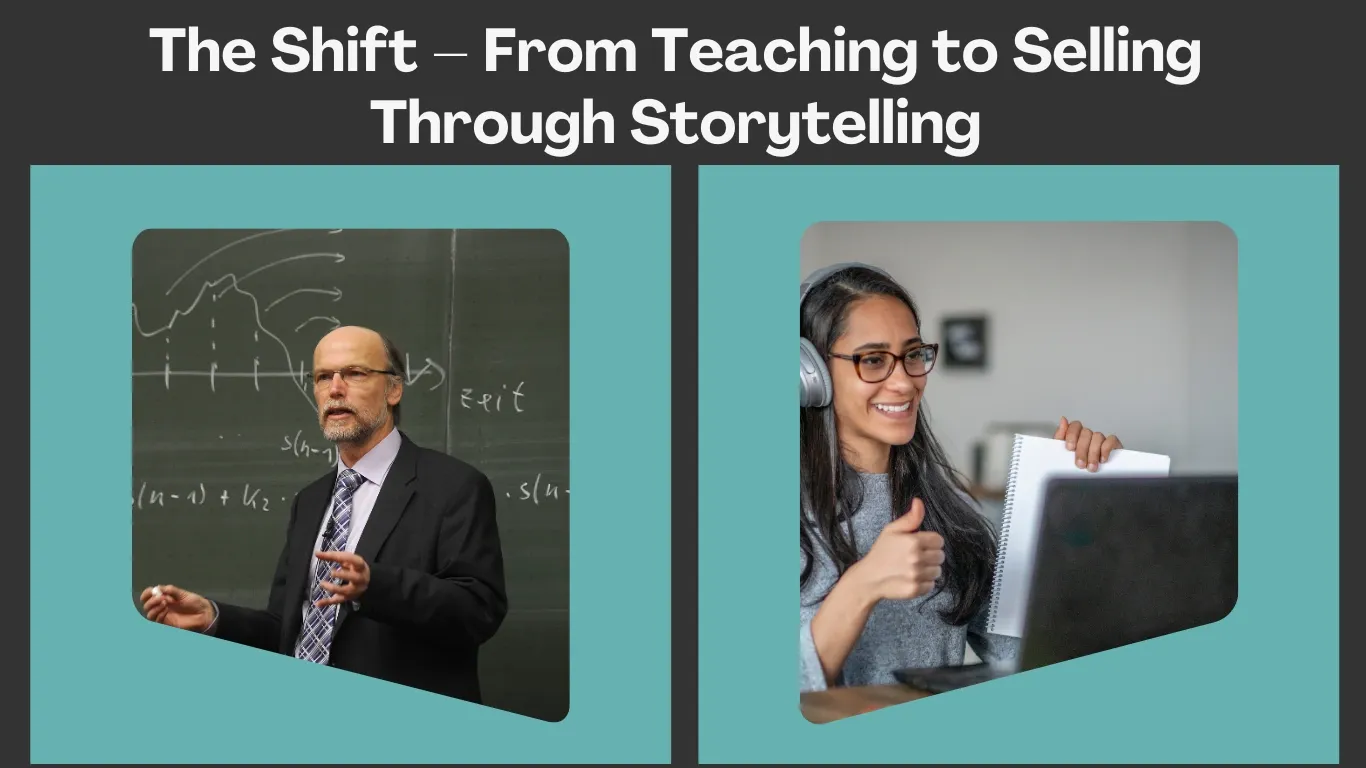
Now that we’ve identified why teaching too much kills sales, let’s explore what actually works in high-converting webinars.
The key?
Shifting from teaching to storytelling.
A successful webinar isn’t about giving attendees a step-by-step guide to solving their problem.
Instead, it’s about making them believe in a new way of doing things—your way.
Here’s how you can make this shift effectively:
1. Teach Less, Inspire More
Your job in a webinar is not to turn attendees into experts—it’s to make them believe that the transformation they desire is possible, and your solution is the fastest way to get there.
Think about it: When people attend a webinar, they don’t just want more information.
They want to solve a specific problem and feel confident about taking the next step.
Instead of overwhelming them with technical knowledge, focus on:
What they need to believe in order to take action.
Why the old way isn’t working and why your method is different.
How your framework can simplify their journey without drowning them in details.
When you inspire instead of over-teaching, attendees shift from passive note-takers to motivated buyers who are eager to work with you.
2. The Power of the Epiphany Bridge
People don’t buy based on logic alone—they buy based on emotion and belief shifts. That’s where the Epiphany Bridge comes in.
Instead of teaching technical steps, tell the story of how you personally discovered the method you now use to get results.
The Epiphany Bridge Story Framework:
The Backstory – What struggle or frustration led you to find this solution?
The Journey – What didn’t work for you before, and why did you need a new way?
The Discovery (Epiphany Moment) – What was the game-changing realization that shifted everything for you?
The Transformation – How did this new way change your life or business?
The Takeaway – How can this same method transform your audience’s life if they follow it?
This type of storytelling pulls your audience in emotionally, helping them see themselves in your journey. When they experience the same epiphany you had, they automatically want to take the next step—without you having to push them.
3. Position Yourself as the Guide, Not Just an Educator
When you teach too much, you position yourself as a teacher—someone giving knowledge for free.
But when you focus on belief-shifting and storytelling, you become a guide—someone who has the roadmap to transformation.
Your audience doesn’t need more DIY solutions.
They need a trusted mentor who can help them implement the solution the right way.
The best way to do this?
Share your own transformation or your students’ success stories.
Use case studies instead of tutorials.
Show them why they can’t afford to do this on their own—and how your offer accelerates their success.
4. Create Curiosity, Not Over-Explanation
One of the biggest mistakes in webinars is giving away all the steps instead of creating curiosity.
Instead of: ❌ "Step 1: Do X, Step 2: Do Y, Step 3: Do Z."
Try: ✅ "I discovered a 3-step process that completely transformed my results.
I’ll walk you through the big picture today, and inside my program, we dive deep into exactly how to implement it for your business."
This approach does two things:
It gives value without making them feel like they can do it alone.
It creates a natural curiosity to learn how they can get full access to the system inside your offer.
When people are curious and excited rather than overloaded, they are far more likely to say YES when you present your offer.
The Shift in Action
Instead of: ❌ Teaching an entire webinar like a free masterclass.
Do this: ✅ Share belief-shifting stories. ✅ Show why the old way isn’t working and why your method is the solution. ✅ Introduce your framework without giving away all the details. ✅ Position your offer as the logical next step.
In the next section, we’ll break down the exact framework for structuring your webinar in a way that builds excitement, creates demand, and converts attendees into paying clients. Stay tuned!
Join our community of like-minded professionals for exclusive tips, strategies, and support.
Let’s grow together—one sale at a time! 🚀
The Framework – How to Structure a Webinar That Sells
Now that you understand why teaching too much kills sales and how to shift from teaching to storytelling, let’s break down the exact structure of a high-converting webinar.
A well-designed webinar isn’t just a random presentation—it’s a carefully crafted journey that moves attendees from curiosity to commitment.
Here’s how to structure your webinar for maximum engagement and conversions:
1. The Hook – Grab Their Attention Immediately
The first few minutes of your webinar are crucial.
You need to capture attention, spark curiosity, and make them excited to stay till the end.
✅ Start with a bold promise:
“How to [achieve desired result] without [biggest struggle]!”
Example: "How to Build a 6-Figure Coaching Business Without Spending a Rupee on Ads!"
✅ Call out their pain point or frustration:
“Are you tired of [struggle]?”
Example: “Are you tired of hosting webinars where people show up but never buy?”
✅ Tease a big breakthrough or secret:
“I’m about to show you something that changed everything for me.”
The goal of the hook is to make attendees feel like they can’t afford to miss the webinar because it holds the key to their transformation.
2. The Big Domino – Shift Their Core Belief
The most powerful part of your webinar is what Russell Brunson calls the Big Domino Statement.
It’s a single powerful idea that, once your audience believes it, makes them naturally want to buy.
Use this formula: "If I can make people believe that [New Opportunity] is the key to [Desired Result] and it’s only attainable through [My System], then they will buy."
✅ Example for a webinar funnel program:
"If I can make you believe that having a high-converting webinar funnel is the key to scaling your coaching business and that my proven framework is the only way to set it up successfully, then you’ll want to join my program."
This is where you position your method as the only real solution to their problem.
3. The Three Secrets – Educate Without Overloading
Instead of teaching a step-by-step process, you want to introduce three key belief shifts that make people excited to invest in your offer.
Each “secret” should: ✅ Challenge a false belief they currently hold. ✅ Present a new perspective that aligns with your offer. ✅ Show them that their previous methods weren’t working.
Example for a Webinar Sales Program:
Secret #1: “Why Teaching Too Much in Webinars is the Fastest Way to Lose Sales”
False belief: “If I give more value, people will buy.”
New belief: “People don’t buy because of how much they learn, but because of how much they believe they need my help.”
Secret #2: “The Epiphany Bridge – How to Sell Without Being Pushy”
False belief: “Selling feels sleazy.”
New belief: “When done right, selling is about guiding people to a transformation.”
Secret #3: “Why You Need a Proven System, Not Just More Information”
False belief: “I can figure this out on my own.”
New belief: “Trying to figure it out alone wastes time. A system gets results faster.”
By the end of these three secrets, attendees should feel like they must work with you because their old way of thinking is no longer serving them.
4. Stacking the Offer – The Smooth Transition to Your Pitch
Many people struggle with the transition from content to pitch.
The secret?
Make your offer feel like the natural next step.
Here’s how to do it smoothly:
✅ Summarize their current struggle:
"Right now, you’re probably feeling [frustration]. You’ve tried [old solutions], but they didn’t work."
✅ Reinforce why your system is different:
"That’s why I created [your system name]—to help you get [desired result] without [common struggles]."
✅ Introduce the offer naturally:
"So, if you’d like my personal guidance to [achieve the result], I want to introduce you to [your program]."
By this point, attendees should already believe they need your system. Your pitch simply gives them the next step to access it.
5. Closing with Urgency – Get Them to Take Action Now
Even if people love your offer, many will hesitate. Your job is to create urgency and remove objections.
✅ Use scarcity:
"This offer is only available for the next 48 hours."
"I’m only taking 10 people this month."
✅ Offer fast-action bonuses:
"If you sign up today, you’ll also get [bonus 1] and [bonus 2]."
✅ Handle objections before they arise:
“Some of you might be thinking, ‘Can I afford this?’ The real question is, can you afford to stay stuck where you are?”
✅ Give a clear call-to-action:
"Click the button below to enroll now and start seeing results."
The Perfect Webinar Structure in Action
Let’s recap the high-converting webinar structure:
✅ The Hook: Grab attention and set expectations. ✅ The Big Domino: Shift a core belief to make the purchase feel inevitable. ✅ The Three Secrets: Break false beliefs and build trust without over-teaching. ✅ Stacking the Offer: Transition naturally into the pitch. ✅ Closing with Urgency: Get attendees to act now, not later.
By using this structure, you can educate, inspire, and convert—without overwhelming your audience with too much information.
In the next section, we’ll cover what to do instead of over-teaching to ensure your webinar leads to more sales and higher engagement.
Join our community of like-minded professionals for exclusive tips, strategies, and support.
Let’s grow together—one sale at a time! 🚀
What To Do Instead? Creating a Webinar That Converts

Now that you know why teaching too much in webinars kills sales and how to structure your webinar effectively, let’s dive into what you should do instead to create a high-converting webinar.
The goal isn’t to overwhelm your audience with information—it’s to shift their beliefs, create desire, and position your offer as the only solution to their problem.
Here’s exactly how to do that:
1. Teach the "What" but Not the "How"
One of the biggest mistakes webinar hosts make is giving away too much of the "how"—the step-by-step details of their method. This makes attendees feel like they can "figure it out on their own" instead of needing your program.
✅ What you should do instead:
Teach WHAT they need to do (the high-level framework).
Show them WHY it’s important and why their current approach isn’t working.
But DON’T teach the exact "HOW"—that’s what your paid program is for.
Example:
❌ "To run successful Facebook Ads, follow these 7 exact steps…" (Over-teaching) ✅ "The reason most Facebook Ads fail is because people don’t understand ad psychology. Inside my program, I show you how to create high-converting ads step by step."
When you hold back the step-by-step implementation, people realize they need your help to get results faster.
2. Use Case Studies Instead of Tutorials
If you spend too much time teaching tactics, attendees feel like they’re in a free workshop rather than an experience designed to help them take action.
Instead, use case studies and success stories to demonstrate your method.
✅ Why this works:
People connect emotionally with real success stories.
They see what’s possible for them without needing every step explained.
It builds credibility while keeping the focus on your offer.
Example:
Instead of explaining how to build a webinar funnel, say: "Let me tell you about [Client Name], who was struggling to sell her course. After implementing my webinar system, she made ₹5L in just 30 days—without spending extra on ads. Inside my program, I walk you through the exact process she followed."
This approach makes people think, "If it worked for them, it can work for me too!"—which naturally leads to more sales.
3. Create Curiosity & Desire Instead of Giving Away All the Details
Your webinar should create demand, not just deliver free content. If you teach too much, people leave satisfied but without urgency to buy.
✅ How to create curiosity:
Drop teasers about what’s inside your program.
Show the big picture but keep the full process exclusive.
Use statements like:
"Inside my program, I walk you through the exact step-by-step blueprint."
"I’ll show you the strategy today, but the execution is what makes the difference—and I guide you through it in my course."
By holding back some key pieces, you make them want access to the full system.
4. Focus on Outcomes, Not Just Information
People don’t buy programs because they want more knowledge—they buy because they want a transformation.
✅ What to do instead:
Talk about results, not just strategies.
Show them how your program will make their life better.
Help them visualize how things will change once they implement your system.
Example:
❌ Teaching-focused approach: “This is how to optimize your sales funnel.” ✅ Outcome-focused approach: “Imagine waking up to sales notifications every morning without manually chasing leads. That’s exactly what my system does for you.”
The more they can see themselves experiencing success, the more they will want your offer.
5. Make Your Offer the Logical Next Step
Instead of making a hard sales pitch, structure your webinar so that by the time you introduce your offer, attendees already believe they need it.
✅ How to make your offer irresistible:
Summarize their struggles and why their old methods haven’t worked.
Reinforce that your framework is the only way to achieve their goal.
Position your program as the shortcut to success.
Example:
"Now you have two options—you can try to figure this all out on your own, wasting months or even years… or you can use my proven system and start seeing results in just 30 days. If you’re serious about transforming your [business/career/health], my program is designed for you."
When your offer feels like the obvious next step, sales happen naturally.
Conclusion: Shift From Information-Giving to Transformation-Selling
To summarize: ✅ Teach the "What," Not the "How" – Create belief without overloading with details. ✅ Use Case Studies, Not Tutorials – Let stories sell for you. ✅ Create Curiosity & Desire – Hold back enough to make them want more. ✅ Focus on Outcomes, Not Just Knowledge – Sell the transformation. ✅ Make Your Offer Feel Like the Next Logical Step – So buying feels natural, not forced.
By making these shifts, you’ll turn your webinar from an information dump into a powerful sales machine.
Your Next Step
Are you ready to transform your webinars into high-converting sales events?
If you want a step-by-step framework to create a webinar that sells without over-teaching, join my [webinar training/course].
Click below to learn how to craft a webinar that turns attendees into paying clients—without overwhelming them with too much information!
👉 [Insert Call to Action – Sign Up for Free Training / Join the Course]
This is how you sell without selling—by making your webinar an experience that naturally leads to YES!
Join our community of like-minded professionals for exclusive tips, strategies, and support.
Let’s grow together—one sale at a time! 🚀
Conclusion
Shift From Teaching to Selling – The Key to High-Converting Webinars
If you’ve been packing your webinars with too much teaching and wondering why people aren’t buying, now you know the truth: Webinars that over-educate don’t convert.
Your audience doesn’t need a free masterclass—they need a belief shift that makes them see why your solution is the best and only way forward.
By making a few key shifts, you can transform your webinar from a lecture into a sales machine:
✅ Teach the "What," Not the "How" – Give them the big picture, not the step-by-step details. ✅ Use Stories & Case Studies Instead of Tutorials – Let real-life success stories do the selling for you. ✅ Create Curiosity & Desire Instead of Over-Explaining – Make them feel like they need your program to get the full solution. ✅ Focus on Transformation, Not Just Information – Sell the outcome, not just the knowledge. ✅ Make Your Offer Feel Like the Next Logical Step – So attendees don’t just learn—they take action.
When you shift from teaching too much to selling through belief-building, you’ll see a dramatic difference in your engagement, conversions, and revenue.
Ready to take your sales game to the next level?
Join our community of like-minded professionals for exclusive tips, strategies, and support.
Join our community of like-minded professionals for exclusive tips, strategies, and support.
Let’s grow together—one sale at a time! 🚀
Frequently Asked Questions
When you teach too much, your audience becomes overwhelmed with information, leading to cognitive overload. Instead of inspiring them to take action, they get stuck in "student mode," focusing on learning rather than buying. The key is to shift their mindset toward seeing your offer as the logical next step.
Providing value is essential, but value doesn’t mean giving away everything upfront. Overloading attendees with details can make them feel they don’t need your product or service. Instead, focus on creating curiosity and showing why your solution is essential.
Teach the "what" and the "why," but avoid the "how." Share the big picture, key concepts, and the transformation your product offers. This creates desire and positions your offer as the next logical step to achieve results.
Use storytelling, case studies, and real-life examples to build emotional connections. Highlight your audience’s pain points and show them the possibilities of transformation through your solution. Emotions drive action, so focus on creating a compelling narrative.
Incorporate limited-time offers, bonuses, or enrollment deadlines to motivate immediate action. Emphasize the cost of inaction, like missed opportunities or continued struggles. Clearly communicate why now is the best time to invest in your solution.
This happens when you provide too much "how-to" information. Instead, show them why trying to figure it out alone can lead to slow progress or mistakes. Position your offer as the shortcut to success, saving them time, effort, and frustration.
Address common objections throughout the webinar using stories, testimonials, and FAQs. Anticipate concerns like price or time and show how your solution solves them. End with a confident call to action that reinforces your offer’s value.
Stories and case studies make your content relatable and emotionally impactful. They help your audience see themselves achieving similar results, which builds trust and desire. Real-life examples are more persuasive than step-by-step teaching.
Use interactive elements like polls, chat prompts, and Q&A sessions to keep them involved. Break up content with visuals, stories, and moments of connection. Keep the focus on their transformation and why your solution matters.
Use a smooth transition by summarizing the problem and highlighting your audience's desired transformation. Show how your offer bridges the gap between where they are and where they want to be. Present your offer as the natural next step to achieve their goals.
